Artificial intelligence is no longer a futuristic concept — it is actively reshaping how organizations hire, manage, and retain talent. AI in HR has moved from being an experimental advantage to an operational necessity, influencing everything from how job descriptions are written to how employee performance is tracked.
The thing which came as “Answer your questions” has now become a very integral part of everyone’s life. It’s not only your personal assistant recommending you the best movies to watch, but it’s also one of the reasons people are losing jobs.
The use of AI in workplaces is no longer optional, but it has become a necessity, regardless of the role or department you work in. It is not only good at assisting with tasks or helping with decision-making, but it can also handle end-to-end jobs from start to finish all by itself.
In this blog, we will get to know how AI is transforming Human resource management
What is AI in HR?
AI in HR refers to the use of AI technologies to carry out HR functions and processes. It is the use of AI technologies and automation tools to save time and reduce costs in HR functions and processes.
According to recent industry data, currently, 40% of HR tasks are automated and AI-assisted, and this is expected to increase to 50% by 2030.
Role of AI in HR
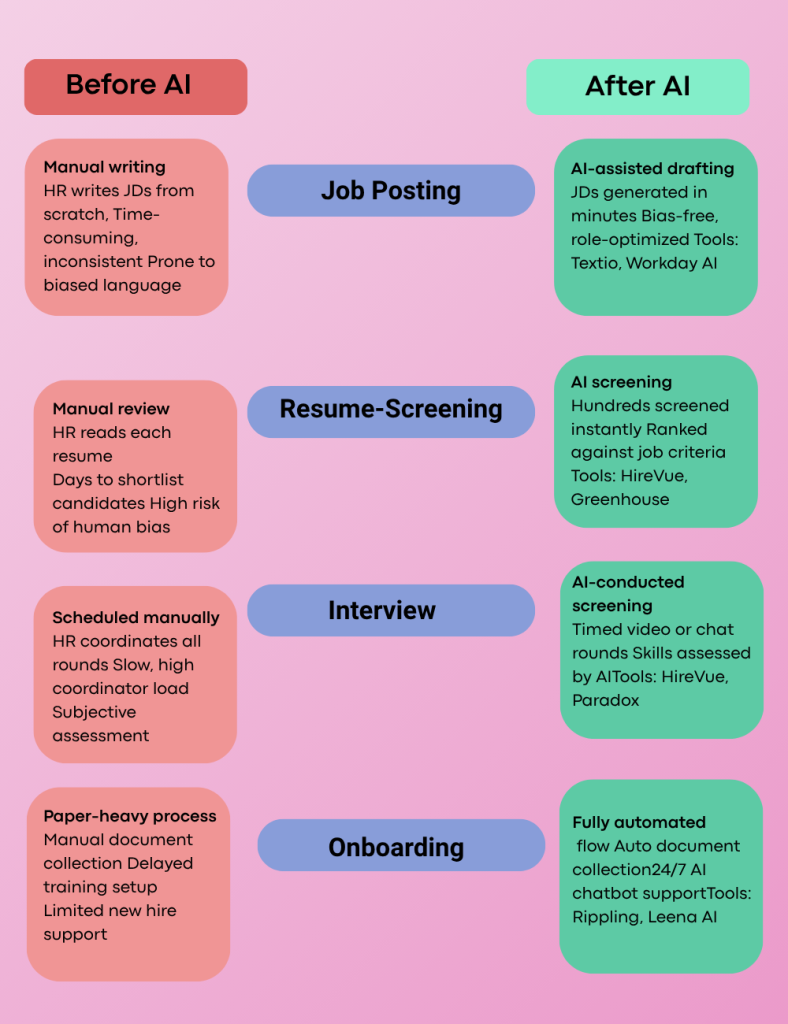
Posting a Job: HR hiring managers are using AI tools like ChatGPT, Textio, and Workday to draft job descriptions, roles and responsibilities, and preferred skill sets, which reduces manual workload.
Resume Screening: Hiring managers use AI tools HireVue and Greenhouse to screen, rank, and score resumes against job descriptions to select the right candidate.
AI-Assisted Interviews: It is the use of AI tools, HireVue and Paradox to conduct and assess candidate skills. Most hiring managers conduct AI interviews as part of the first-round screening. It usually includes timed video interviews or chat interactions.
Onboarding New Hires: Integrating AI tools to automate repetitive administrative tasks such as sending documents, verifying documents, providing training, and offering 24/7 assistance, reducing manual work.
Employee Engagement: AI tools are used to track performance, attendance, payroll management, and benefits management
What AI Cannot Replace in HR?
Leadership & Influence: AI cannot be capable of guiding, directing, and leading a team of real human beings towards achieving a shared vision and common goals.
Contextual Decision-Making: AI tools are not yet expert enough to make decisions when there is context, not just data. So, human intelligence, emotions, and ethics are still going to stay relevant.
Empathy & Emotional Intelligence: HR is more about people, teams, and culture. AI is not capable of understanding people’s emotions and grievances, which is one of the major roles in HR.
The Future of AI in HR
Will AI continue to replace tasks?
Well, HR is not just about tasks. It is a complex, human-centric approach that is not limited to hiring the right people, but it is also one of the key drivers of overall organizational culture and growth.
HR is responsible for people growth in an organization. It is responsible for maintaining culture, retaining employees, improving employee satisfaction, and therefore increasing the overall growth of the organization through empathy and emotional intelligence.
Conclusion
If you’re someone who works in HR or wants to work in HR, then you should continue updating yourself in this fast-paced, changing environment. The future model is human + AI collaboration.
AI will not replace HR, but HR professionals who don’t adapt to AI might struggle to stay relevant.
AI will not replace HR. But HR professionals who don’t adapt to AI might find it harder to stay relevant.
If you work in HR or are planning a career in it, now is the time to embrace AI as a tool — not fear it as a threat.